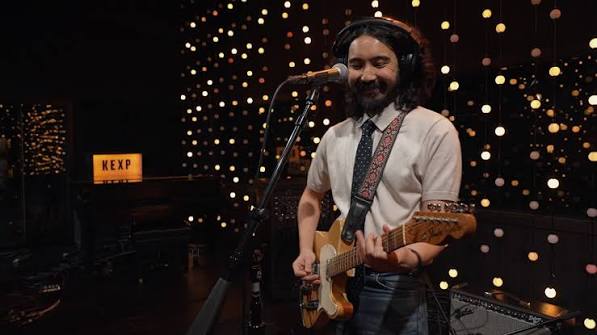
The night Makara’s KEXP live session landed, I ended up outside Speakerbox watching it back on somebody else’s phone.
A few of us had drifted into the smoking area between sets. Some people recognised the KEXP logo immediately. Others already knew the band and wanted to hear how the session sounded. At one point somebody replayed the opening again jjust to see how it started.
Thanks for reading! Subscribe for free to receive new posts and support my work.
There isn’t much introduction. A brief welcome from host Diana Ratsamee and then the band are already playing.
Watching it later in that context, that opening felt significant in a way I didn’t quite realise at first.
Not because the Bangkok-based were the first band to perform in Thai on KEXP, although they are. Not because it represented some game-changing breakthrough moment for Thai music internationally. What stayed with me was how little effort anybody involved seemed to make to explain what was happening.
The songs arrive fully formed – the listener is expected to catch up.
That feels obvious until you consider how often music from Thailand and Southeast Asia has historically been introduced to international audiences through explanation first. Context arrives before sound. The audience is told why the music matters before they are allowed to encounter it on its own terms.
Makara’s session works differently. The music gets there first. It’s a special kind of confidence that suits the band.
I’ve always thought Makara’s strongest material operates through trust. Songs like “COCO” don’t rush to justify themselves. They don’t chase climaxes particularly hard. A guitar figure appears, settles into place, repeats, then repeats again. The rhythm section locks underneath it. Tiny shifts begin accumulating weight. What initially feels static gradually reveals itself as movement. The session captures that beautifully.
Nothing about the performance feels adapted for an international audience. The songs aren’t shortened, the language isn’t explained. The band simply play as though the audience already belongs there.
I personally associate this sort of Thai psych with a live environment alongside a crowd, where I first experienced it. The yelling, the dancing from people who can’t help it, the sweaty bodies moving in a circle. So one of the things that surprised me most revisiting this session was how much detail survives outside the tactile in-person live show. The bass occupies more space than it often does in clubs. The relationship between the drums and the guitars becomes easier to follow. Familiar psych and blues vocabularies continually brush against rhythmic instincts that feel rooted somewhere else entirely.
Makara have often been described through molam, and understandably so, but what has always interested me more is how naturally those influences sit inside the music. The songs don’t feel like fusion projects. They feel like they emerged from a place where those sounds have already been living together for a long time.
That’s partly why the language never feels like an obstacle. You don’t need to understand Thai to understand what the songs are doing physically. The grooves still pull, the repetitions accumulate force.
The songs still move.
Reading through the comments underneath the session afterwards, what stood out wasn’t surprise but familiarity.
People talked about tones, grooves and production choices. Comparisons appeared between Russian psych, Japanese underground rock and contemporary psych scenes elsewhere in Asia. The discussion resembled the kind of conversation that happens whenever listeners encounter music they genuinely want to spend time with.
When you look at previous YouTube gems of Thai music that managed to capture an international audience years ago, conversations around Southeast Asian music often sounded different. The music itself wasn’t different.
The listening was.
When Western underground audiences encountered music from Thailand, Indonesia or elsewhere in the region, it often arrived through the language of rediscovery. Crate-diggers. Reissue labels. YouTube rabbit holes. Forgotten psych compilations. The music was frequently extraordinary, but the framing encouraged listeners to approach it almost archaeologically, as though the primary excitement came from uncovering something hidden.
Reading responses to Makara’s session,that instinct seemed absent.
People weren’t listening for lost treasures – they were listening for contemporary connections.
The conversation moved sideways rather than backwards. Comparisons emerged naturally between scenes, bands, guitar sounds and rhythmic approaches. Listeners weren’t treating the music as an artefact that had surfaced from somewhere distant. They were treating it as part of the same conversations they were already having.
They’re listening horizontally, not archaeologically.
Years ago, I was sitting in a bar when a friend told me the now-folkloric story of Khun Narin Electric Phin Band. YouTube uploads. An American label discovering the group online. Somebody travelling halfway across the world to find musicians playing village festivals in Isaan.
A few weeks later, I happened to be in Khon Kaen and saw them myself. What I remember isn’t the discovery story.
I remember being there with friends who had mostly come to see Desktop Error. The sort of people who some might think were too cool for molam, who were bored of the Isaan sound they had heard so much growing up. Then Khun Narin started playing.
The repetitions stretched out and the groove locked in.
Whatever distinction existed between people who had come for the molam and people who hadn’t gradually disappeared as people started being unable to resist the movement.
The discovery narrative was real enough. The American label really did find them online. But standing there, the story didn’t matter anymore compared to seeing it existing as a living thing in real time with real people.
The music wasn’t discovered, it was established, and it was still living.
Looking back, that’s probably the difference between how many people encountered Southeast Asian music ten years ago and how they’re encountering it now. The music hasn’t changed nearly as much as the listening has.
A similar thing happened in Bali last year while sharing music with a friend from Java, a lover of koplo and other local forms. He started playing me dangdut records one evening and I realised I’d already been hearing those rhythms for weeks. In taxis, in karaoke bars, drifting out of warungs and passing scooters. The music wasn’t new to me – I simply hadn’t learned how to hear it yet.
Months later, standing in a venue in Bangkok while a DJ called Dangdut Banget filled the room with many of those same rhythms, they sounded completely familiar.
The music hadn’t changed. I had.
The longer I spend around music in Southeast Asia, the more that experience seems to repeat itself.
Living in Bangkok, you occasionally encounter visitors reacting to local scenes with genuine excitement and a degree of disbelief, as though finding shoegaze bands, underground rappers, hardcore scenes, experimental electronics or psychedelic rock contradicts expectations of what Thailand appears to be for many on the outside. I understand the instinct because I’ve experienced versions of it myself, I still struggle with it sometimes.
After a while, though, the surprise starts feeling as strange as the music you’re listening to.
Thailand has never been culturally isolated. Neither has the rest of Southeast Asia. These scenes have spent decades absorbing, reshaping and exporting influence through migration, piracy, touring, diaspora and countless informal networks that rarely leave much documentation behind.
What has changed is not the existence of those connections but their visibility.
Earlier this year, after an AXEAN showcase in Bangkok, I found myself outside Blueprint Livehouse talking with Diana Ratsamee. Door Plant had just played alongside some brilliant artists from Indonesia and the Philippines. The conversations afterwards felt familiar to anyone who has spent time around festivals or showcases. Recommendations exchanged, tours were discussed, smokes were shared over laughs and social media swaps.
What struck me talking to Diana was how little separation seemed to exist between the musical worlds being discussed. Thai music, Indonesian music, Filipino music – none of it was a curiosity.
They already belonged to the same conversation.
That probably shouldn’t have surprised me. Diana has spoken before about growing up around Thai and Southeast Asian music through family and community alongside American alternative music. For her, these sounds weren’t things to be discovered later in life. They were already part of the environment. Familiar rather than exotic; contemporary rather than archival.
Which perhaps explains why the session begins the way it does – a short introduction and then the music. No lengthy cultural framing. No attempt to explain Thailand or the sounds before introducing a Thai language band. Just good music.
Hardcore scenes arrived at that understanding years ago. Long before institutions started paying attention to Southeast Asia, bands were already building relationships and recognising each other’s scenes through message boards, tape exchanges and touring networks. Places like Concrete Jungle aren’t simply festivals, venues like Gimme Shelter in Bali don’t simply put on shows. They are information hubs, meeting points. They are infrastructure. By the time outsiders noticed many of those connections, the people involved had often known each other for a long time.
The same thing continues across genres now.
You see it in Whispers sharing stages with Speed.
In JPBS touring China and Japan.
In the way bands like Fazi and bed move between Asian and European circuits without needing to be framed as cultural discoveries first.
You even see it in KEXP itself.
The week after Makara’s session aired, Indonesian indie band Grrrl Gang released their own. Makara and Grrrl Gang sound almost nothing alike. One arrives through repetition and psych molam. The other through jangling guitar pop and indie rock rooted in 90s post-punk.
What connects them is not style but circumstance. Neither session relies on explanation.
The music starts and the audience follows.
For years, international conversations around Southeast Asian music often positioned Western listeners as discoverers. The underlying assumption was that the music became visible once Western institutions noticed it.
By the time Makara walked into KEXP’s studio, those connections already existed. In diaspora communities. In touring networks. In festival circuits. In the countless recommendations, friendships and chance encounters that make scenes possible in the first place.
KEXP doesn’t create the movement, it arrives in the middle of it.
Which is why, for me, the most striking thing about Makara becoming the first Thai-language band to perform on KEXP isn’t the fact that it happened. It’s how natural it felt when it did.
Later that night outside Speakerbox, somebody asked for the link whilst the song was still ringing out.
The phone changed hands.
The music kept moving.
Hi, this is a comment.
To get started with moderating, editing, and deleting comments, please visit the Comments screen in the dashboard.
Commenter avatars come from Gravatar.